
News
Powering Africa’s Industrial Growth: Why Efficient Motors Matter More Than Ever
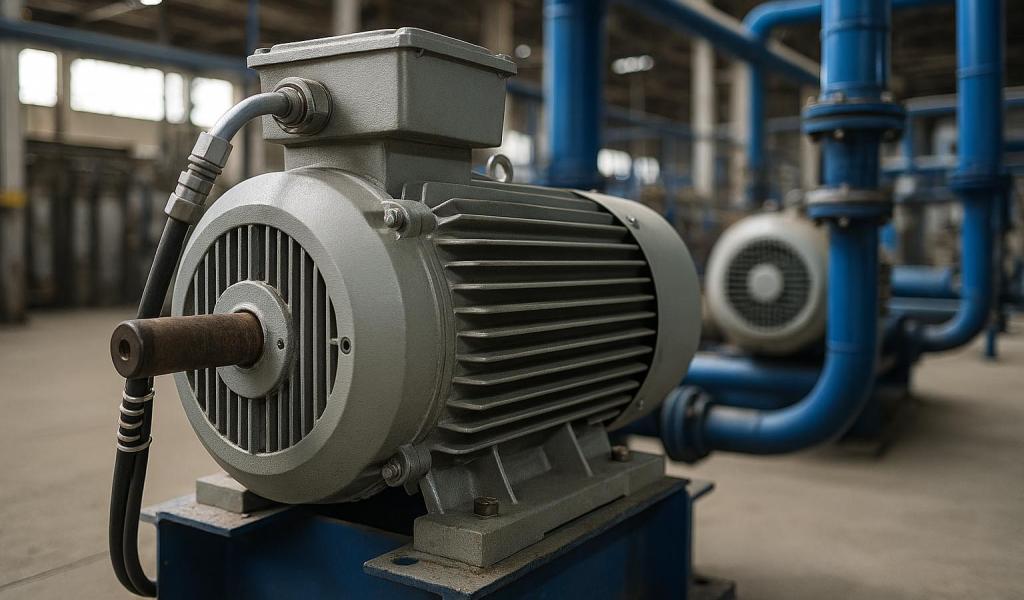
Industrial motors power the majority of essential processes in African manufacturing. They run pumps, drive conveyors, operate cooling systems, and enable the productivity that sustains industry and jobs. Yet behind this indispensable role lies one of the continent’s greatest untapped opportunities for energy savings. Industry accounts for a major share of electricity demand across the region. And within industry, as much as 70% of total electricity consumption is driven by motors. When such a critical component is inefficient, everything downstream becomes more costly. But the opposite is also true: improving motor efficiency has an immediate and transformative impact.
Every step up in motor efficiency, from IE1 to IE2, or from IE2 to IE3, etc. typically reduces electricity consumption by around 15 to 20% compared to the lower-efficiency class. Since motors alone typically influence 20 to 30% of a factory’s electricity bill, even a moderate upgrade can deliver meaningful reductions in operational costs. Across the 15 African countries analyzed, the shift to high-efficiency motor systems could generate more than USD 1.5 billion in annual energy cost savings collectively. That is monetary savings that industries could reinvest in jobs, competitiveness, and innovation.
It is also important to recognize that Africa does not need to follow the same slow transition seen in other regions. In Europe, it took nearly two decades to move away from outdated IE0 and IE1 motors toward the now-dominant IE3 and IE4 technologies. African industries have the advantage of technological maturity already existing globally. With enabling policies, financing, and partnerships, the region can leapfrog directly to efficient motor systems and reap economic, social and environmental benefits much faster.
However, the solution does not stop with replacing a single piece of equipment. Motor systems are complex. Energy can be lost through poor power quality, improper controls, misaligned couplings, or inefficient pumps and fans attached to the motor. The real savings come from optimizing the entire system, ensuring the electricity paid for is fully converted into productive work. This approach matters because motors are everywhere in factories. Around one-fifth drive pumps. Nearly as many operate compressors. And countless others support ventilation, cooling, and material handling. When performance is improved on a systems level, the results compound rapidly. For example:
- Choosing the proper coupling element can improve your factory’s motor system efficiency significantly.
- For motors serving variable loads, VSDs (Variable Speed Drives) can dramatically reduce energy use and maintain high efficiency across different speeds.
- When multiple compressors serve the same network, proper control and coordination can significantly improve system efficiency.
To explore how African industries can unlock the full potential of high-efficiency motor systems, the EELA Program will host a webinar on 15 January 2026, open to participants from sub-Saharan countries. Experts from Chemonics Egypt will share practical strategies for reducing electricity consumption, improving motor system management, and leveraging opportunities from transitioning to more energy-efficient technologies. The session will feature examples and case studies from Kenya, Zambia, Zimbabwe, Ghana, South Africa, Egypt, and others, providing actionable insights to support immediate implementation. The registration link will be published shortly on our website and social media channels.