
WEBINAR
Webinar Series #14: Industrial Urban Symbiosis, a New Frontier for Energy and Resource Efficiency
Industrial urban symbiosis is an emerging concept in energy and resource efficiency, gaining traction in countries that have already implemented strong energy efficiency measures and are now seeking innovative solutions beyond the “low-hanging fruit.” At its core, industrial urban symbiosis refers to collaboration between industries and urban environments to create value from residual resources - such as waste heat, water, materials, and byproducts - rather than discarding them. This approach is not geographically constrained and can be applied in diverse contexts, including African countries, as highlighted by Karl Lindblad, Sustainable Energy Expert at the Swedish Energy Agency, during the webinar organized under the EELA Program on 2 December 2025.
Energy efficiency remains the backbone of Sweden’s energy transition strategy, with a national goal of becoming fifty percent more energy efficient by 2030 compared to 2005. Sweden has already achieved significant progress, maintaining stable energy consumption despite continuous GDP growth, but traditional efficiency measures are reaching saturation. The easiest improvements have been implemented, and new systemic approaches are needed. Industrial urban symbiosis offers such an approach by focusing on secondary resource use, reducing the need for primary resource extraction and minimizing environmental impact. For example, waste heat recovery reduces the need for new energy production and grid expansion, water reuse avoids costly purification processes, and material cascading extends the lifecycle of resources across multiple industries.
Implementing industrial urban symbiosis requires moving from single-actor optimization to multi-actor systems, which introduces complexity in technical, legal, and financial dimensions. Current legislation in Sweden defines waste in a way that imposes strict handling requirements, limiting secondary use. Legal reforms are needed to reclassify certain waste streams as resources. Financial gaps also exist because projects often involve multiple actors with shared infrastructure needs, such as district heating networks. Neither party can bear the full cost, creating a role for state intervention or public-private financing models. Scale adds another layer of complexity: large industries generate significant residual flows, but connecting them with smaller actors requires innovative business models and matchmaking platforms. Existing permitting frameworks treat each actor as an isolated system, which is incompatible with interconnected resource flows. Authorities must collaborate to streamline multi-actor permitting processes and develop new governance models.
The Swedish Energy Agency is studying several aspects of industrial urban symbiosis to address technical, legal, and financial challenges. Current efforts focus on mapping existing projects, analyzing residual resource flows such as waste heat and byproducts, and engaging stakeholders to identify barriers and policy needs. Preliminary insights highlight the importance of legal flexibility for secondary resource use, financial instruments to bridge infrastructure gaps, and mechanisms to facilitate collaboration between large and small actors.
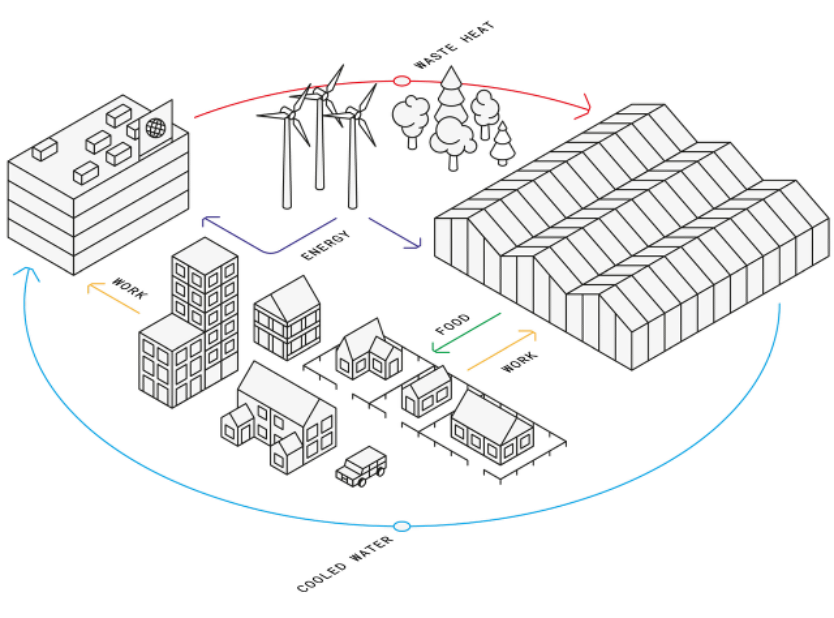
Regenergy Frövi, an example of industrial Symbiosis: a 100,000 m² state-of-the-art greenhouse powered by 35 GWh of residual heat from Billerud’s paper mill, producing 8,000 tonnes of tomatoes annually and creating over 100 new jobs.
Several Swedish examples illustrate the potential of industrial urban symbiosis. Regenergy Frövi operates a 100,000-square-meter greenhouse in the district of Frövi, using thirty-five gigawatt hours of residual heat from a local paper mill via a simple pipeline to produce eight thousand tons of tomatoes annually and create over one hundred jobs. Plans include integrating biological leftovers into aquaculture for circular nutrient flows. In the case of Visby-Vimmerby, industries, agriculture, and municipalities collaborate to reuse purified industrial wastewater for irrigation, addressing freshwater scarcity on the island. The Sotenäs Symbiosis Network represents a large-scale cluster where agricultural and fishery byproducts are converted into biogas and fertilizers, supported by shared water purification infrastructure that serves multiple industries. Bengtsfors offers a small-scale example where woodworking leftovers and discarded carpets are transformed into new design products, combining resource efficiency with local job creation and helping counter rural depopulation.
Industrial urban symbiosis is not limited by geography. The first step for African countries is to map local waste streams and primary resource use, then identify potential linkages. Success depends on stakeholder engagement to build trust and awareness, policy reforms to reclassify waste as a resource, and financial incentives to support infrastructure and matchmaking. As Lindblad emphasized, progress will come from local solutions tailored to specific resource flows, supported by national strategies that encourage collaboration across industries and authorities.